Automotive under-hood air
Representative part: short air or vacuum runs. Ask service temperature and oil mist. IATF 16949 is a plant-system question, not proof of the coil.
BUYER SUPPORT / FIRST ORDER
Compare quotes from up to 3 factories
FREE basic specification and sourcing-requirements review
Eligible first orders may receive up to 3%
Eligibility applies to qualified business buyers and is confirmed after we review your product, quantity, destination, and sourcing requirements. Final savings depend on supplier confirmation, product type and order value.
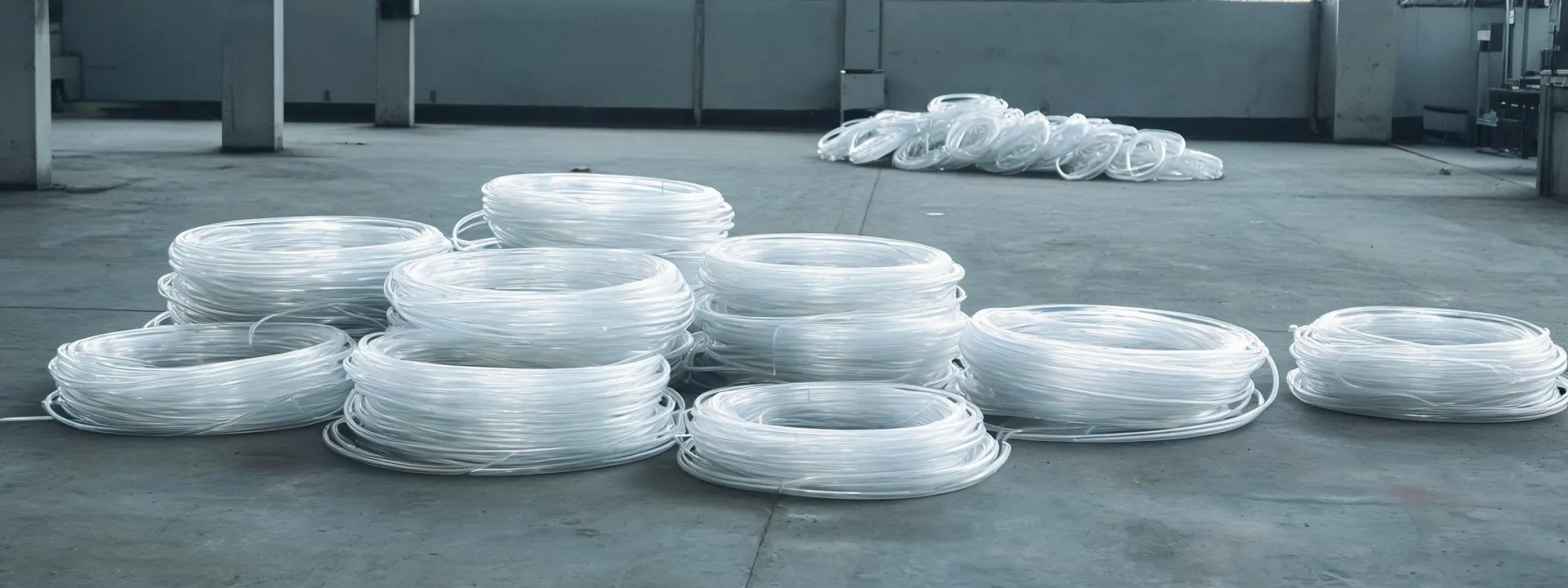
Translate an installation into purchase requirements for nylon 6 tubing. This page does not promise a result, a moisture number or a heat deflection temperature. Those answers belong to a named factory for a named grade.
Each card is a purchasing context. Certification names are files to request for a grade, not badges this desk issues.
Representative part: short air or vacuum runs. Ask service temperature and oil mist. IATF 16949 is a plant-system question, not proof of the coil.
Representative part: machine pneumatic jumpers. Inner and outer diameter must match the fitting already on the valve island.
Representative part: non-product air or drain lines. FDA 21 CFR 177 applies only when the buyer asks for that page on that grade.
Representative part: cable-adjacent air lines. UL 94 is a plastics flammability question if the receiving plant needs it — not a default.
Representative part: temporary pneumatic feed on site. This desk does not install pipe or repair lines in the United States.
Representative part: non-implant utility tubing. USP Class VI or ISO 10993 files, if required, must name the grade and lot.
| Axis | Thermal | Chemical / medium | Mechanical | Compliance file |
|---|---|---|---|---|
| Ask the factory | Service temperature in °F or °C; heat deflection temperature if the plant uses HDT | Air, oil mist, water, or named fluid; moisture uptake for nylon 6 versus nylon 12 | Tensile strength in MPa or psi for the quoted grade; wall in inches or millimetres | REACH SVHC, RoHS, FDA 21 CFR 177 only if the brief requires that page |
| Buyer keeps | Continuous versus peak temperature on site | Whether a neighbouring PTFE or silicone tube is even in scope | Inner and outer diameter pair; cut length | Whether a plant ISO 9001 poster is accepted as a substitute (this desk says no) |
| Leave blank if unknown | Do not invent a −40 to 200 °C window | Do not copy a competitor oil-resistance slogan | Do not reprint an elongation-at-break catalogue number | Do not treat USP Class VI as implied by the word nylon |
Nylon 6 (PA6) is the larger-volume engineering resin for many air and lube lines. It also picks up more moisture, which can change dimensions after extrusion. Nylon 12 (PA12) is often specified when the buyer wants lower moisture uptake and a different low-temperature window. Neither grade is “better” on this page. If the drawing says nylon 6 tubing, a nylon 12 offer is a written substitute, not a courtesy upgrade.
Thermoplastic nylon tube runs on extrusion, can be cut and reworked, and is the family this site opens. Vulcanized rubber hose still wins when the job is a dynamic, high-temperature, oil-soaked line that needs compression set the thermoplastic cannot hold. Do not let a salesperson convert a rubber-hose duty into a nylon tube coil without rewriting temperature, medium and working pressure in psi or bar.
Procurement situation, not a review: a plant engineer writes “nylon 6 tubing for a 140 °F wash-adjacent air line.” Until the medium, the continuous temperature and whether nylon 12 is allowed are written, two extrusion plants will quote two different constructions.
Desk scenario · wash-adjacent air line
Write temperature, medium and destination. Results stay unpromised.
Discuss Sample Needs